 3 Simple Ways to Bring Eco-Friendly Play into a Montessori Home
Montessori education teaches us to make the world as authentic and tangible as possible for children. “Help me to do it myself” lies at the heart of this philosophy. But how can we use the same approach to help children develop a deep appreciation for nature?
Eco-conscious play and Montessori complement each other beautifully. Both value natural materials, meaningful experiences, and hands-on learning. Here are three simple ways to combine sustainability and creativity in your child’s Montessori-inspired everyday life.
A Montessori environment places great value on real materials such as wood, glass, and metal because they give children realistic sensory feedback through weight, texture, and temperature.
The same idea can be applied to art materials.
Conventional wax crayons are often made from petroleum-based paraffin and packaged in unnecessary plastic. A more mindful alternative is to choose plant-based materials.
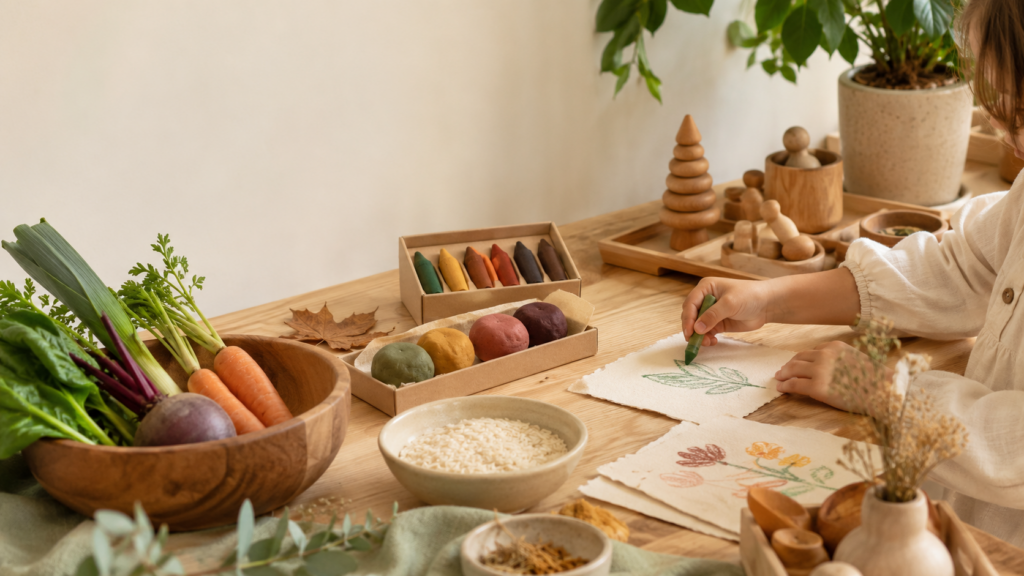
Our rice and vegetable crayons are made using rice bran ingredients and real vegetable materials. Their gentle, earthy colours bring children closer to nature while offering a more thoughtful alternative to conventional art supplies.
Children in Montessori environments learn by exploring the world with all their senses.
Instead of relying only on strongly scented or highly synthetic modelling compounds, sensory activities can be created with simple materials inspired by everyday life and the kitchen.
When there is no time to make salt dough at home, vegetable play dough can offer a convenient alternative. Its soft texture is easy for small hands to shape and mould, while the natural-looking colours are inspired by ingredients such as spinach and carrot.
Kneading, rolling, and shaping also help strengthen fine motor skills and encourage open-ended creative play.
Children often understand complex ideas best through practical experiences.
Creative time can be a wonderful opportunity to talk about where materials come from.
Where does paper come from?
What is color made from?
What happens to materials after we use them?
Try using collected leaves, leftover cardboard, or recycled paper as a canvas. Then introduce crayons inspired by flowers, vegetables, and other natural sources.
These small conversations can help children understand ideas such as reuse, upcycling, and giving materials a new purpose.
In this way, sustainability becomes something they can see, touch, and experience for themselves.
The environment we create for children can influence how they relate to the world around them later in life.
By choosing more thoughtful, natural, and sustainable materials for play and creativity, we show children that nature is something to value, respect, and protect.
Would you like to make your child’s Montessori-inspired environment more natural and colourful?
Discover our carefully selected creative products inspired by vegetables, rice, and flowers.